11:45 PM. A business traveler arrives at their hotel after a delayed flight, exhausted and eager for bed. The front desk has a line six people deep—other late arrivals, a family with crying children, someone arguing about a reservation mix-up. The wait stretches to 25 minutes. Finally reaching the desk, they provide ID, sign paperwork, receive plastic key cards, listen to elevator directions they don't retain, and trudge to their room. It's now 12:15 AM. What should have been instant rest became a 30-minute ordeal.
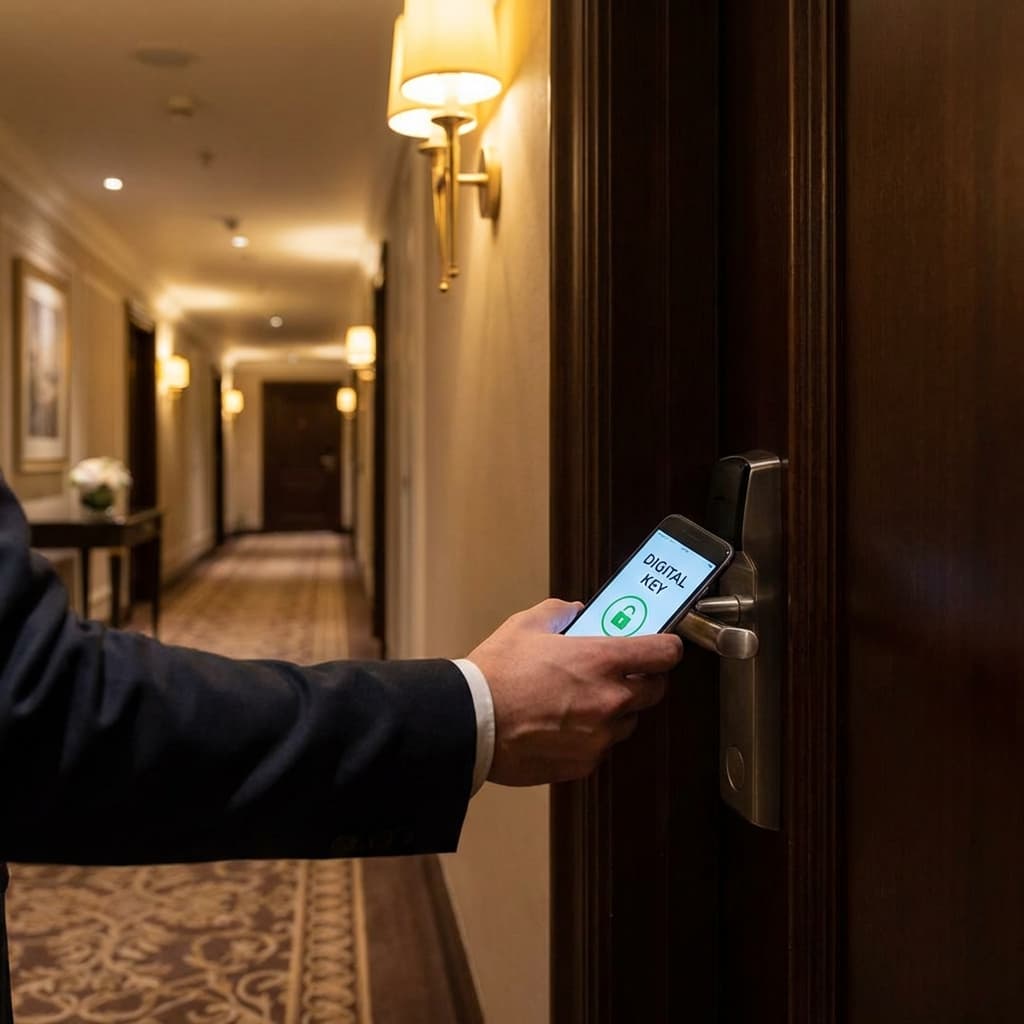
Meanwhile, at a hotel across town, another traveler with the same late flight walks past the empty front desk (it's unstaffed at this hour), directly to their pre-assigned room, and taps their smartphone against the door. It unlocks immediately. They're unpacked and in bed by 11:50 PM.
The difference? Mobile check-in and NFC digital room keys. What was once a futuristic novelty is rapidly becoming standard at forward-thinking properties. The traditional hotel check-in process—designed decades ago when guests required face-to-face interaction to receive physical keys—no longer serves modern travelers' needs or expectations.
NFC technology, combined with mobile apps, enables "straight-to-room" experiences that eliminate lines, reduce labor costs, improve guest satisfaction, and position hotels as technology leaders. The question isn't whether to implement mobile check-in—it's how quickly your property can deploy it before competitors do.
The Problem with Traditional Hotel Check-in
To understand the revolution, examine what's broken.
The Front Desk Bottleneck
Check-in is inherently inefficient:
Peak Arrival Times: Most hotels experience arrival surges:
- 3-6 PM: Standard check-in time
- Late evening: Delayed flights, late travelers
- Early morning: International arrivals, red-eyes
During these windows, front desks are overwhelmed. Lines form. Wait times stretch. Guests who've been traveling for hours must stand longer.
Transaction Time: Traditional check-in takes 5-8 minutes per guest:
- Verification (ID, reservation lookup): 1-2 minutes
- Paperwork (registration cards, signatures): 1-2 minutes
- Payment processing (pre-authorization, payment method update): 1-2 minutes
- Key programming and issuance: 30-60 seconds
- Information delivery (WiFi password, breakfast times, amenity locations): 1-2 minutes
Multiply by 10-20 simultaneous arrivals, and even well-staffed desks struggle.
Staffing Requirements: Hotels must maintain front desk coverage 24/7, even during slow periods. Labor represents 40-50% of hotel operating costs. Front desk staffing is a significant portion.
Guest Frustration: Business travelers cite "slow check-in" as a top complaint. Every minute waiting is a minute not working, resting, or enjoying their destination.
The Plastic Key Card Problem
Physical room keys create ongoing issues:
Lost or Forgotten Cards: 15-20% of guests lose or forget cards during their stay, requiring:
- Return to front desk
- Re-verification
- Programming new card
- Disposal of old card (security risk if found by wrong person)
Demagnetization: Cards stored near phones, credit cards, or other magnetic items demagnetize, rendering them useless. Guests must return to front desk for replacement.
Environmental Waste: Hotels issue millions of plastic key cards annually. Most are disposed after a single use (guests forget to return them, or cards are discarded). This creates unnecessary plastic waste.
Security Limitations:
- Cards are easily duplicated
- Lost cards remain active until guest reports and hotel deactivates
- No way to verify who's using the card (authenticate the card, not the person)
- Former guests sometimes keep cards, necessitating periodic room lock reprogramming
Checkout Process: Hotels request card returns at checkout, but 30-40% of guests forget. Staff must track down cards or write them off as lost.
The Personalization Gap
Modern travelers expect personalized experiences, but traditional check-in offers none:
One-Size-Fits-All: Every guest receives the same information (WiFi password, breakfast times, pool hours) regardless of their actual needs or interests.
Missed Upsell Opportunities: Front desk staff vary in their ability to upsell room upgrades, spa services, or dining reservations. Digital channels enable consistent, data-driven upselling.
Language Barriers: International guests may struggle with English-speaking front desk staff. Digital check-in can be presented in guests' native languages.
Accessibility Challenges: Guests with hearing or speech difficulties find front desk interactions challenging. Digital alternatives remove this barrier.
The Mobile NFC Solution
NFC-enabled smartphones transform the guest experience.
How Hotel Mobile Check-in Works
Pre-Arrival:
- Guest books reservation (online, via app, or through agent)
- 24-48 hours before arrival, hotel sends notification: "Check-in is now available"
- Guest completes mobile check-in via hotel app:
- Confirms arrival time
- Verifies payment method
- Selects room preferences (floor level, bed type, view)
- Reviews hotel information
- Agrees to terms digitally
Digital Key Delivery: 4. Hotel assigns room and generates digital key 5. Digital key sent to guest's smartphone (via app or added to Apple Wallet/Google Pay) 6. Guest receives notification: "Your room is ready. Room 412. Tap your phone to unlock"
Arrival: 7. Guest arrives, bypasses front desk entirely 8. Goes directly to elevator (some hotels allow elevator call via app) 9. Proceeds to assigned room 10. Taps smartphone against NFC-enabled door lock 11. Door unlocks, guest enters
Total Time from Parking to Room: 2-5 minutes (vs. 15-30+ with traditional check-in)
The Technology Stack
Mobile App: Hotel-branded app (or integration with third-party platforms like Hilton Honors app, Marriott Bonvoy app) handles:
- Reservation management
- Mobile check-in process
- Digital key delivery
- Guest services (room service, concierge requests, etc.)
Digital Key Credentials: Encrypted credentials stored securely on smartphone:
- Works offline (no internet required at door)
- Time-limited (automatically expires at checkout time)
- Revocable (hotel can remotely deactivate if needed)
NFC Door Locks: Smart locks on guest room doors:
- Battery-powered (2-3 year battery life)
- Communicate with hotel property management system via Wi-Fi/Ethernet
- Support both NFC smartphones and backup physical key cards
- Log every access attempt (security audit trail)
Property Management System (PMS): Backend system managing:
- Room assignments
- Digital key generation and distribution
- Access permissions and expiration
- Integration with other hotel systems (billing, housekeeping, etc.)
Cloud Platform: Centralized management for:
- Multi-property hotels (guest checks into different properties using same app)
- Data analytics (adoption rates, guest satisfaction, operational efficiency)
- Remote troubleshooting
Implementation Approaches
Option 1: App-Based System Guests download hotel's branded app.
Pros:
- Full control over user experience
- Direct marketing channel (push notifications, promotions)
- Comprehensive feature set (beyond just digital keys)
- Brand reinforcement
Cons:
- Guests must download app (friction point)
- App development and maintenance costs
- Storage space on guests' phones
Best For: Large hotel chains with significant guest loyalty
Option 2: Wallet Integration (Apple Wallet, Google Pay) Digital keys added to smartphone's native wallet.
Pros:
- No app download required (lower friction)
- Familiar user experience
- Works with phone locked
- Minimal phone storage
Cons:
- Limited to iOS/Android wallet features
- Less customization
- Fewer touchpoints for hotel marketing
Best For: Independent hotels, boutique properties, budget-conscious implementations
Option 3: Hybrid Approach Offer both app-based and wallet-based keys, letting guests choose.
Pros:
- Maximum guest flexibility
- Captures both app-users and app-avoiders
Cons:
- More complex technical implementation
- Support for multiple systems
Best For: Mid-size chains, properties targeting diverse demographics
Key Features Beyond Basic Unlock
Leading implementations go beyond simple room access:
Elevator Integration: App calls elevator and automatically selects guest's floor. Elevator restricts access to only authorized floors (prevents wandering or unauthorized access).
Amenity Access: Use same digital credential to access:
- Fitness center
- Pool area
- Executive lounge
- Business center
- Parking garage
Room Personalization: Before arrival, guest selects preferences via app:
- Temperature (room pre-cooled or pre-heated)
- Lighting scenes
- TV channel preferences
- Pillow type
Room configured automatically before guest arrives.
Housekeeping Coordination: Guest indicates via app whether room service is desired:
- "Please clean room" or "Do not disturb"
- Preferred housekeeping time
- Special requests (extra towels, hypoallergenic bedding)
Housekeeping optimizes routes based on real-time requests.
Contactless Checkout: Guest checks out via app (verifies charges, provides feedback). No front desk visit required. Digital key automatically deactivates at checkout time.
Messaging Platform: Two-way communication with hotel staff via app:
- Request amenities
- Ask questions
- Report maintenance issues
- Make reservations
Reduces phone calls and front desk visits.
Implementation Guide for Hotels
Step-by-step deployment.
Step 1: Assess Readiness
Property Audit:
- Number of rooms
- Current lock system (mechanical keys, magnetic stripe, RFID)
- Property management system (does it support mobile key integration?)
- Wi-Fi infrastructure (adequate coverage for smart locks?)
- Guest demographics (tech comfort level)
Strategic Alignment:
- Does mobile check-in fit brand positioning?
- What percentage of guests would adopt?
- What's the competitive landscape? (Are competitors offering this?)
- ROI timeline acceptable?
Stakeholder Buy-In:
- Ownership/management (budget approval)
- Front desk staff (job role changes)
- IT team (infrastructure requirements)
- Housekeeping (workflow changes)
- Security (risk assessment)
Step 2: Select Vendor/Platform
Leading Hotel Lock Providers:
- Assa Abloy (Mul-T-Lock, Corbin Russwin): Enterprise-grade, extensive hotel installations
- Dormakaba: Strong hospitality focus, good PMS integrations
- Salto: Wireless solutions, cost-effective for mid-size properties
- Onity (by United Technologies): Major market player, comprehensive offerings
- OpenKey: Cloud-native, app-first approach, good for tech-forward properties
Evaluation Criteria:
- PMS Integration: Seamless connection with your existing property management system (Opera, Maestro, Cloudbeds, etc.)
- Mobile Platform: App-based, wallet-based, or both?
- Scalability: Can system grow with property or multi-property portfolio?
- Guest Experience: How easy is enrollment and daily use?
- Staff Tools: Dashboard for managing access, troubleshooting issues, generating reports
- Security: Encryption standards, certifications, audit capabilities
- Support: Response times, on-site assistance, training
- Pricing: Upfront costs (hardware), ongoing costs (licensing, support), hidden fees
Step 3: Pilot Program
Never roll out property-wide immediately.
Pilot Scope:
- One floor (10-20 rooms)
- 3-6 months duration
- Invite tech-savvy guests to participate
- Maintain traditional check-in as option
Pilot Goals:
- Validate technical functionality
- Test guest adoption and satisfaction
- Identify staff training needs
- Measure operational efficiency gains
- Calculate actual ROI
Metrics to Track:
- Mobile check-in adoption rate
- Digital key usage rate
- Front desk transaction reduction
- Guest satisfaction scores
- Technical support requests
- Cost savings
Step 4: Incremental Rollout
Phased deployment based on pilot learnings.
Phase 1: Loyalty Members (20-30% of guests)
- Frequent travelers most likely to appreciate innovation
- Already have hotel app installed
- Provide valuable feedback
Phase 2: General Guest Population (50-60%)
- Offer mobile check-in to all guests
- Maintain traditional check-in for those who prefer it
- Market benefits prominently
Phase 3: Default to Mobile (80-90%)
- Make mobile check-in the default (still allow traditional as exception)
- Front desk shifts focus to concierge services, problem resolution, guest relations
Communication:
- Pre-arrival emails explaining mobile check-in
- In-app tutorials
- Signage in lobby directing to mobile check-in instructions
- Staff trained to assist guests with enrollment
Step 5: Optimize and Expand
Continuous improvement post-launch.
Monitor Performance:
- Daily adoption rates
- Technical issues and resolution times
- Guest feedback and ratings
- Operational cost savings
- Front desk traffic reduction
Expand Features:
- Start with basic room access
- Add amenity access (fitness center, pool)
- Integrate elevator control
- Implement room personalization
- Enable full contactless checkout
Scale Across Properties:
- For multi-property chains, replicate successful model
- Enable single app for guests across all properties
- Centralized management and reporting
Cost-Benefit Analysis
Detailed ROI for mobile check-in implementation.
Investment: 100-Room Hotel
Hardware:
- NFC-enabled smart locks: 100 rooms × $200 = $20,000
- Installation labor: $5,000
- Additional access points (elevator control, amenity doors): $3,000
Total Hardware: $28,000
Software:
- Mobile platform (app development or licensing): $15,000-$50,000 (one-time)
- PMS integration: $5,000-$15,000
- Cloud platform subscription: $500-$2,000/month = $6,000-$24,000/year
Total Software: $26,000-$89,000 first year
Training and Change Management:
- Staff training: $3,000
- Guest communication materials: $2,000
Total Training: $5,000
Grand Total First Year: $59,000-$122,000
Annual Benefits
Labor Savings: Reduce front desk staffing by 30% during peak hours:
- 2 FTE equivalents × $30,000 salary = $60,000/year saved
Plastic Key Card Costs: Eliminate or dramatically reduce:
- 15,000 cards/year × $0.50 = $7,500
- Key card printer maintenance: $1,500
Total Card Savings: $9,000/year
Increased Guest Satisfaction: Higher ratings drive bookings:
- 0.5-point increase in guest rating scores
- Estimated 3-5% increase in direct bookings
- For 70% occupancy, 100 rooms, $150 ADR: ~$400,000 additional revenue
- 4% increase = $16,000/year
Upsell Revenue: Mobile platform enables targeted in-app upsells:
- Room upgrades, spa services, dining
- Estimated 2-3% increase in ancillary revenue
- For $100,000 existing ancillary revenue: $2,000-$3,000 increase
Total Annual Benefit: $87,000-$88,000
Net ROI:
- First Year: $87,000 - $59,000 to $122,000 = $-35,000 to $28,000 (breakeven 8-14 months)
- Subsequent Years: $87,000 - $6,000 to $24,000 (software only) = $63,000-$81,000 annual benefit (270-1,350% ROI)
Intangible Benefits:
- Competitive differentiation
- Enhanced brand perception (modern, tech-forward)
- Data for operational optimization
- Foundation for broader smart hotel features
Future Trends
Hotel technology is evolving rapidly.
Ultra-Personalization
AI-powered guest profiles:
- Room auto-configures based on past stays (temperature, lighting, TV channels)
- App suggests activities based on preferences and local events
- Predictive room service (breakfast reminder based on usual order time)
Voice Integration
"Alexa, unlock my hotel room door" or "Hey Google, order room service."
Biometric Access
Face recognition or fingerprint doors—no phone needed. Guest's face or print is the key.
Integrated Smart Rooms
Mobile app controls:
- Window shades
- Thermostat
- TV and streaming services
- Room lighting scenes
- Wake-up alarms
Blockchain Loyalty
Decentralized guest identity and loyalty points across multiple brands/properties.
Sustainability Tracking
Guest app shows environmental impact:
- Energy saved by opting out of daily housekeeping
- Water conserved
- Carbon offset options
Conclusion: The Frictionless Future of Hospitality
The hotel industry faces evolving guest expectations. Travelers accustomed to seamless digital experiences in every other aspect of life—banking, shopping, entertainment, transportation—now demand the same from hospitality.
Long wait times, lost key cards, and inflexible check-in processes feel increasingly antiquated. Mobile check-in and NFC digital keys represent not just convenience, but a fundamental reimagining of the guest journey.
For guests, it's liberation: straight-to-room access, personalized experiences, control via familiar smartphone interfaces.
For hotels, it's operational excellence: reduced labor costs, better data, enhanced guest satisfaction, competitive differentiation.
The technology is proven, the costs are manageable, the benefits are measurable. Major chains (Hilton, Marriott, Hyatt) have deployed mobile keys across thousands of properties. Independent and boutique hotels can now access similar technology at reasonable cost.
The question isn't whether mobile check-in becomes standard—it's how quickly your property adopts it before guests come to expect it everywhere.
Your guests already carry the key in their pockets. Your hotel just needs to unlock the door.
Welcome to the frictionless future of hospitality—where check-in is invisible, access is instant, and guest satisfaction soars.