Event organizers are always looking for ways to streamline check-ins and improve attendee engagement. Two technologies dominate this space: NFC (Near Field Communication) and QR (Quick Response) codes. But which one is right for your event?
The answer isn't always simple. Both technologies have specific strengths and ideal use cases. Understanding these nuances can mean the difference between a smooth, memorable event experience and one plagued by bottlenecks and frustration.
Understanding the Technologies
Before comparing them, let's clarify what each technology actually is and how it works:
QR Codes: The Visual Approach
QR (Quick Response) codes are two-dimensional barcodes that store information in a pattern of black squares on a white background. Developed in 1994 for automotive manufacturing, they've found widespread adoption for consumer applications.
How They Work:
- Information is encoded into a visual pattern
- User opens camera app on smartphone
- Camera focuses on the QR code
- Software decodes the pattern
- Action is triggered (open URL, display text, etc.)
Key Characteristics:
- Requires line of sight and proper focus
- Needs adequate lighting
- Works on any smartphone with a camera
- Can be printed on any medium (paper, fabric, screens)
- Free to generate and use
- Can be damaged and still work (up to 30% error correction)
NFC: The Proximity Approach
NFC is a wireless communication protocol that allows devices to exchange data over very short distances (typically 4cm or less). It evolved from RFID technology and has become standard in modern smartphones for contactless payments.
How It Works:
- Information is stored on a chip or tag
- User taps smartphone near the NFC tag
- Electromagnetic field transfers data
- Action is triggered instantly
Key Characteristics:
- Requires physical proximity but not line of sight
- Works in any lighting condition
- Requires NFC-capable device (iPhone 7+, most Android phones)
- Tags require purchase but are reusable
- Faster than QR codes (no focusing required)
- More secure (extremely short range prevents remote interception)
The Head-to-Head Comparison
Speed and User Experience
QR Codes: The typical QR code scan takes 3-8 seconds:
- Pull out phone (1 second)
- Open camera app (1-2 seconds)
- Position and focus on code (2-4 seconds)
- Tap notification to open link (1 second)
In poor lighting or if the code is damaged, this can extend to 10-15 seconds or fail entirely.
NFC: The typical NFC tap takes 1-2 seconds:
- Pull out phone (1 second)
- Tap against tag (instant recognition)
- Action triggers automatically (less than 1 second)
Winner: NFC - Significantly faster, especially at scale. For an event with 1,000 attendees, this speed difference compounds dramatically:
- QR: 5,000-8,000 seconds (83-133 minutes) total check-in time
- NFC: 1,000-2,000 seconds (17-33 minutes) total check-in time
Reliability and Environmental Factors
QR Codes: Performance degrades under:
- Low light (evening events, dim venues)
- Bright sunlight (screen glare)
- Damaged or wrinkled printouts
- Small code sizes (hard to focus on)
- User holding phone unsteadily
Failure rate: 10-20% requiring rescan in typical event conditions.
NFC: Performance is consistent across:
- Any lighting condition (works in complete darkness)
- Doesn't require visual clarity
- Tags can be encased in protective materials
- No positioning precision required
Failure rate: 1-3% in typical conditions (usually due to phone case thickness or user error).
Winner: NFC - More reliable across varied conditions, especially problematic lighting.
Device Compatibility
QR Codes:
- Works with any smartphone camera (iOS, Android, others)
- Works with older phones
- Works with tablets and some laptops
- Universal accessibility (nearly 100% of smartphones)
NFC:
- Requires NFC chip in device
- iPhone 7 and later (released 2016)
- Most Android phones from 2014 onward
- Not supported on some budget Android models
- Approximately 75-80% of smartphones in developed markets
Winner: QR Codes - Broader compatibility, especially for budget devices and older phones.
Security Considerations
QR Codes: Security vulnerabilities:
- Can be photographed from a distance and replicated
- Easy to create counterfeit tickets
- QR code swapping attacks (replacing legitimate codes with malicious ones)
- Phishing risks (malicious URLs in codes)
- No encryption of data within the code itself
NFC: Security advantages:
- Extremely short range (4cm) makes remote interception nearly impossible
- Can use encrypted data
- More difficult to counterfeit (requires chip duplication)
- Supports secure authentication protocols
- Real-time validation possible
Winner: NFC - Significantly more secure for applications requiring authentication or payment.
Cost Considerations
QR Codes:
- Free to generate (many online tools)
- Printing costs only (pennies per code)
- Can be displayed on screens (zero marginal cost)
- No hardware required beyond existing smartphones
Total event cost estimate for 500 attendees:
- Badge printing with QR codes: $150-300
- Scanner devices (if using dedicated readers): $200-500
- Total: $150-800
NFC:
- Tag costs: $0.50-$5 per tag depending on type
- Can be reused for multiple events
- May require NFC-capable badges or cards
- Some phones may need cases removed for better reception
Total event cost estimate for 500 attendees:
- NFC-enabled badges: $500-2,000 (but reusable)
- No scanner devices needed (use phones)
- Total: $500-2,000 initial (drops significantly for repeat events)
Winner: QR Codes - Lower upfront cost, especially for one-time events.
Data Capacity
QR Codes:
- Can store up to 7,089 numeric characters or 4,296 alphanumeric characters
- Large data capacity allows for complex information
- Larger data = larger code size = harder to scan
NFC:
- Standard tags: 144-888 bytes depending on chip type
- Sufficient for URLs and basic contact info
- Limited for complex data structures
Winner: QR Codes - Higher data capacity for complex use cases.
Brand Experience and Perception
QR Codes:
- Familiar to most users (pandemic accelerated adoption)
- Can be visually integrated into designs
- Feels utilitarian rather than premium
- "Point and shoot" interaction
NFC:
- Feels more modern and sophisticated
- "Tap and go" mirrors contactless payment familiarity
- Perceived as more premium
- Cleaner aesthetic (tags can be hidden or subtle)
Winner: NFC - Better for premium event experiences.
Use Case Analysis: When to Use Each
Best Use Cases for QR Codes
1. Large-Scale Public Events Events with diverse attendees who may have older phones:
- Music festivals
- Free community events
- Public conferences with broad demographics
Why: Maximum compatibility ensures no one is excluded.
2. Print-Heavy Applications When information needs to be on paper:
- Posters and flyers promoting the event
- Printed programs or schedules
- Handouts and brochures
Why: QR codes integrate seamlessly with printed materials.
3. Budget-Constrained Events When minimizing upfront costs is critical:
- Nonprofit fundraisers
- Student organizations
- Small community gatherings
Why: Near-zero cost to implement.
4. Information-Rich Applications When you need to convey complex information:
- Detailed session descriptions
- Full speaker bios and presentations
- Comprehensive venue maps
Why: Higher data capacity than NFC.
5. Outdoor Events in Good Weather Daytime events with adequate lighting:
- Sports tournaments
- Outdoor markets
- Daytime conferences
Why: Environmental conditions favor QR scanning.
Best Use Cases for NFC
1. High-End Corporate Events When brand experience and efficiency matter:
- Executive conferences
- Product launches
- VIP networking events
- Trade shows with professional attendees
Why: Speed, sophistication, and premium feel align with brand positioning.
2. Events with Fast-Paced Check-Ins When minimizing queue time is critical:
- Concerts and live performances
- Sports events with timed entries
- Multi-session conferences with session-to-session movement
Why: 3-5x faster than QR codes at scale.
3. Evening or Low-Light Events When lighting conditions are suboptimal:
- Galas and fundraising dinners
- Nightclub events
- Evening networking mixers
Why: NFC works perfectly in darkness.
4. Events Requiring Security When ticket fraud or unauthorized entry is a concern:
- High-value events (expensive tickets)
- Exclusive invite-only gatherings
- Events with VIP areas
Why: NFC is harder to counterfeit and easier to validate in real-time.
5. Interactive Badge Applications When networking or gamification is key:
- Professional conferences with attendee networking
- Trade shows with exhibitor interactions
- Corporate events with engagement tracking
Why: NFC badges enable tap-to-exchange contact info, tap-to-enter contests, tap-to-collect exhibitor data.
Hybrid Approach: Best of Both Worlds
Many sophisticated events use both technologies strategically:
The Dual-Coded Badge
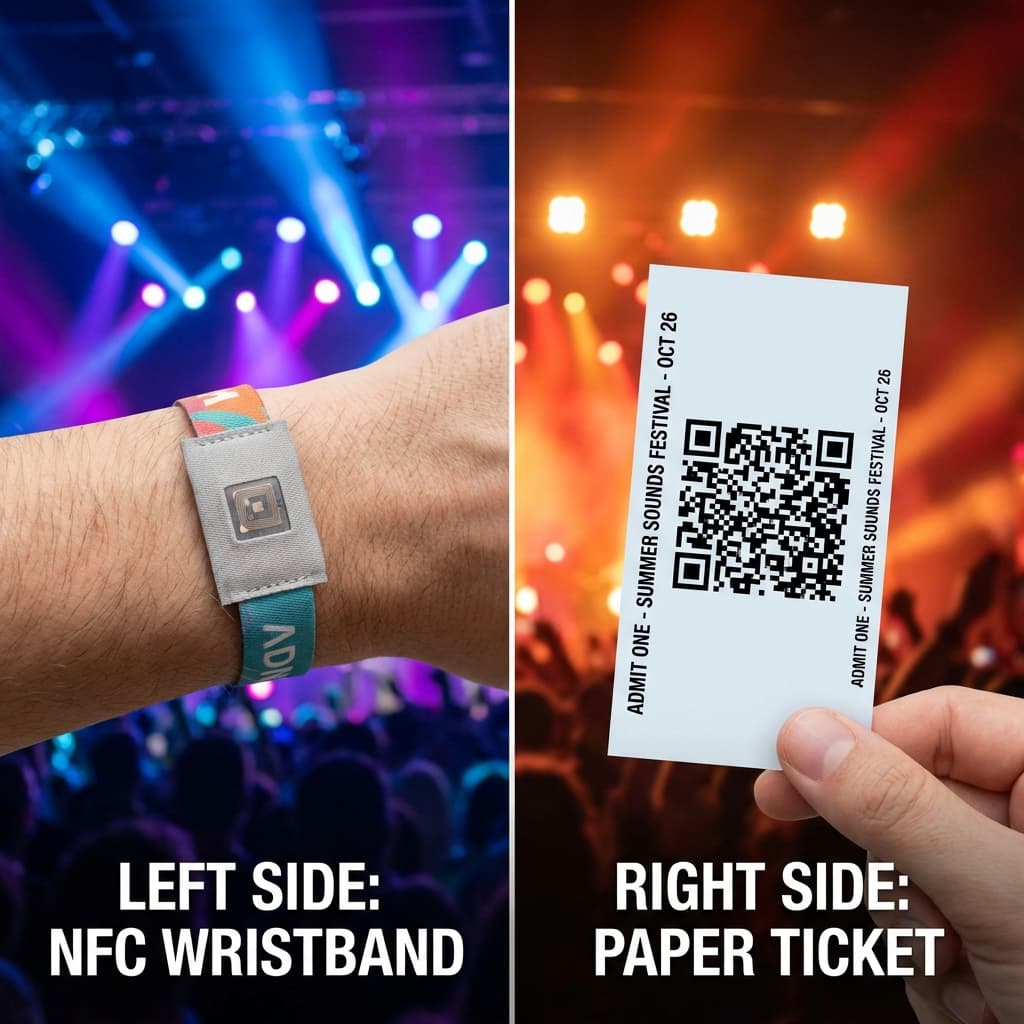
Event badges include both QR code and NFC tag:
QR Code Side:
- Used for visual check-in at registration desks (staff scan)
- Printed session schedules and agendas
- Information lookup
NFC Tag Side:
- Fast attendee-initiated check-ins at sessions
- Networking (tap to exchange contact info)
- Interactive booth experiences
- Payment integration (if applicable)
Implementation:
- QR code printed on front of badge
- NFC tag embedded in badge material
- Cost: $3-7 per badge
- Covers 95%+ of attendees regardless of phone capabilities
Strategic Placement by Context
Use different technologies in different situations:
Main Event Entrance: NFC
- Speed is critical (long lines form quickly)
- Professional staff can assist with tech issues
- One-time high-stakes interaction
Session Rooms: QR Codes
- Multiple entry points reduce per-point throughput requirements
- Attendees self-scan, no staff needed
- Lower cost to equip every room
Exhibitor Booths: NFC
- Premium feel for sponsor interactions
- Quick tap-and-go keeps traffic flowing
- Trackable data for sponsors (they pay for it)
Take-Home Materials: QR Codes
- Printed brochures and swag bags
- Follow-up communications
- Post-event engagement
Implementation Guide by Event Type
Corporate Conference (500-2,000 Attendees)
Recommended: NFC-Primary with QR Backup
Setup:
- NFC-enabled badges for all attendees
- Backup QR codes on confirmation emails
- NFC check-in stations at entrance
- Staff with tablets for manual check-in (backup)
Budget:
- NFC badges: $1,500-6,000
- Badge printing: $500-1,500
- ROI: Faster check-in improves attendee experience, reducing wait complaints
Expected Results:
- Check-in time: 30-60 seconds per person
- Failure rate: <5%
- Attendee satisfaction improvement: Significant (no long queues)
Music Festival (10,000+ Attendees)
Recommended: QR-Primary (Wristband or Mobile)
Setup:
- QR code on digital ticket (email/app)
- QR code on printed wristband (for those without smartphones)
- Multiple scanning lanes with dedicated staff
- RFID upgrade for VIP wristbands (faster re-entry, cashless payments)
Budget:
- QR code generation: Free
- Wristband printing: $0.50-2 per wristband = $5,000-20,000
- Scanner devices: $3,000-10,000 (reusable)
Expected Results:
- Check-in time: 5-10 seconds per person
- Device compatibility: 100%
- Budget-friendly: Yes
Trade Show with Exhibitor Engagement
Recommended: Hybrid (NFC Badges + QR Booth Codes)
Setup:
- NFC-enabled attendee badges
- Exhibitors have NFC readers at booths (tap to collect attendee info)
- QR codes at booths as backup
- Leaderboard showing most-visited booths
Budget:
- NFC badges: $3,000-8,000 for 1,000 attendees
- Exhibitor NFC readers: Provided as part of booth package
- Analytics platform: $500-2,000
Value Proposition:
- Sell to exhibitors: "Tap-to-collect lead data worth thousands in sponsorship fees"
- ROI: Increased exhibitor satisfaction → higher renewal rates
Networking Event (50-200 Attendees)
Recommended: NFC-Only
Setup:
- Premium NFC business cards or badges
- Tap-to-exchange contact information
- Real-time networking leaderboard
- Post-event follow-up automation
Budget:
- NFC cards/badges: $150-1,000
- Platform for contact exchange: $100-500
Experience:
- Feels premium and exclusive
- Seamless networking (no fumbling with phone numbers)
- High engagement and satisfaction
Technical Implementation Tips
For QR Code Events
1. Size Matters: Make codes large enough to scan easily:
- Minimum: 2cm x 2cm
- Optimal: 4cm x 4cm or larger
- For stage displays: Much larger (test from back of venue)
2. Error Correction: Use high error correction level (H) for codes that might get damaged:
- Allows up to 30% of code to be damaged/dirty
- Slightly larger code size
- Much more reliable in real-world conditions
3. Testing: Test QR codes with multiple devices before printing thousands:
- Different iPhone models
- Different Android devices
- In various lighting conditions
- At different angles
4. Contrast: Ensure high contrast between code and background:
- Dark code on light background (best)
- Avoid low-contrast combinations
- Don't print on reflective materials
For NFC Events
1. Tag Placement: Position tags where attendees will naturally tap:
- Top center of badge (most common tap location)
- Avoid placing near metal (interferes with signal)
- Test tag-to-tag distance (multiple tags too close can interfere)
2. Phone Case Accommodation: Some thick cases block NFC:
- Provide signage: "Remove thick cases if needed"
- Train staff to recognize and assist
- Consider higher-power tags if budget allows
3. Tap Guidance: Clear visual cues for where to tap:
- "Tap Here" icon on badges
- Demonstrate at registration
- Staff modeling correct behavior
4. Backup Systems: Always have backup for failed reads:
- Manual entry via staff tablet
- Backup QR code on same badge
- Check-in kiosk for self-service troubleshooting
Cost-Benefit Analysis Example
Scenario: 1,000-Person Tech Conference
Option A: QR Code System
- QR badge printing: $500
- Scanner devices (5): $1,000
- Staff for scanning (5 people × 2 hours × $20/hr): $200
- Total: $1,700
- Check-in time: 60-90 minutes
- Attendee experience: Acceptable
Option B: NFC System
- NFC badges: $3,000
- Platform/software: $500
- Self-service kiosks (attendees use own phones): $0
- Staff for assistance only (2 people × 1 hour × $20/hr): $40
- Total: $3,540
- Check-in time: 20-30 minutes
- Attendee experience: Excellent
ROI Analysis:
- Additional cost: $1,840
- Time saved per attendee: 2-3 minutes
- Total time saved: 2,000-3,000 minutes (33-50 hours)
- Value of attendee time (avg $50/hr): $27,500-41,700
- Attendee satisfaction improvement: High (shorter waits)
Conclusion: For professional audiences with valuable time, NFC justifies higher cost.
Future Trends
Ultra-Wideband (UWB)
The next evolution beyond NFC:
- Precise location tracking (know exactly where attendees are in venue)
- Longer range than NFC (up to 10 meters)
- Automatic check-in as you walk through entrance
- Apple and Samsung already deploying in premium phones
Timeline: Mainstream adoption for events by 2027-2028.
Facial Recognition
Completely touchless check-in:
- Look at camera, instant recognition
- No badge needed
- Privacy concerns to address
Timeline: Pilot deployments already happening; broader adoption within 2-3 years.
Blockchain Ticketing
NFT-based tickets with NFC integration:
- Verifiable authenticity
- Transferable with trail
- Collectible event memorabilia
Timeline: Early adoption now in crypto/tech events; mainstream TBD.
Conclusion: Choose Based on Your Priorities
The NFC vs. QR debate isn't about which technology is "better" in absolute terms—it's about which is better for your specific event.
Choose QR Codes if:
- Budget is the primary constraint
- Attendee demographics include significant older/budget phone users
- Event is one-time only (no badge reuse)
- Outdoor daytime event with good lighting
Choose NFC if:
- Speed and efficiency are critical (large event, limited time)
- Premium brand experience matters
- Low-light or variable lighting conditions
- Security and fraud prevention are important
- Event series (badges can be reused)
- Networking and interactive features desired
Choose Both if:
- Maximum compatibility is required
- Budget allows for premium experience with broad backup
- Different contexts within event benefit from different technologies
The most important factor isn't the technology itself—it's understanding your attendees, your constraints, and your goals. Start there, and the right choice becomes clear.
Your event's success depends on dozens of factors, but choosing the right check-in technology ensures attendees start their experience with ease rather than frustration. That first impression sets the tone for everything that follows.
Choose wisely, test thoroughly, and always have a backup plan. Your attendees will thank you.