A child stands before a 2,000-year-old Roman artifact, squinting at a small placard with dense text describing the object's historical significance. Within seconds, their attention wanders. A parent reads aloud from the description, but the words feel academic and distant. The artifact—once touched by ancient hands, witness to extraordinary events—sits silently behind glass, its stories locked away.
This scene plays out millions of times daily in museums worldwide. Cultural institutions invest heavily in acquiring, preserving, and displaying remarkable objects, yet struggle to make those objects truly engaging for modern audiences, especially younger generations raised on interactive digital experiences.
Traditional museum interpretation—text panels, printed brochures, rented audio guides—hasn't fundamentally changed in decades. Meanwhile, visitor expectations have been transformed by smartphones, podcasts, YouTube, and augmented reality. The disconnect is growing.
NFC (Near Field Communication) technology offers museums a solution that bridges this gap: transforming static exhibits into interactive, multimedia experiences using visitors' own smartphones. No hardware rentals, no hygiene concerns, no batteries to charge. Just tap and discover.
The Challenge: Making Museums Relevant to Modern Audiences
Before exploring NFC solutions, let's understand the deeper challenges museums face.
The Attention Crisis
Museum visitor attention spans have decreased dramatically:
- Average time spent viewing an artwork: 15-30 seconds
- Percentage of visitors who read full text panels: less than 20%
- Average museum visit duration: declining year-over-year
- Competition for attention: infinite digital content always available on phones
Museums aren't just competing with other cultural institutions—they're competing with TikTok, Netflix, Instagram, and every other digital distraction.
The Audio Guide Problem
Traditional audio guides seemed like an answer. Visitors rent a handheld device, enter numbers corresponding to exhibits, and listen to narration.
The Problems:
- Hygiene Concerns: Shared devices go from ear to ear, raising health concerns even before COVID-19 made this intolerable for many visitors
- Cost and Logistics: Museums must purchase devices ($50-150 each), maintain them (charging, cleaning, repairing), staff rental desks, and handle returns
- Limited Adoption: Many visitors skip audio guides entirely due to rental fees ($5-10), perceived hassle, or unfamiliarity
- Inflexibility: Content is fixed on devices, making updates expensive and infrequent
- User Experience: Clunky interfaces, dead batteries, and confusing numbering systems frustrate users
A $200,000 investment in audio guide infrastructure might serve only 15-20% of visitors, and those who use it often find the experience disappointing.
The Generational Divide
Museums face a demographic challenge:
- Older Visitors (65+): Comfortable with traditional museum experiences, less tech-savvy, represent significant donor base
- Middle-Aged Visitors (35-64): Mixed comfort with technology, value education for their children
- Younger Visitors (18-34): Expect digital integration, short attention spans, less likely to visit museums regularly
- Children and Teens: Raised on interactive screens, find passive observation boring
Creating experiences that engage all demographics simultaneously is tremendously difficult with traditional interpretation methods.
The Information Depth Problem
Museum text panels face an impossible constraint: limited physical space. A 150-word panel can provide only surface-level information. Visitors with deeper interest have nowhere to go for more.
Audio guides help but still operate within strict time limits—overly long narration causes visitors to walk away mid-explanation.
Meanwhile, every visitor arrives with different knowledge levels and interests. The classical music expert wants different information about a historic violin than a casual visitor. One-size-fits-all content serves no one optimally.
The Language Barrier
Museums in tourist destinations face multilingual challenges:
- Printing text panels in multiple languages consumes valuable wall space
- Audio guides require separate devices or complex menu systems for language selection
- Translation costs accumulate (professional translation for 200 exhibits in 5 languages is a substantial expense)
- Updates multiply work (change one exhibit text, translate into all languages)
Many museums simply offer content in only 1-2 languages, excluding international visitors.
The NFC Solution: Interactive Museums on Visitors' Phones
NFC technology transforms how visitors engage with exhibits while solving the problems outlined above.
How Museum NFC Systems Work
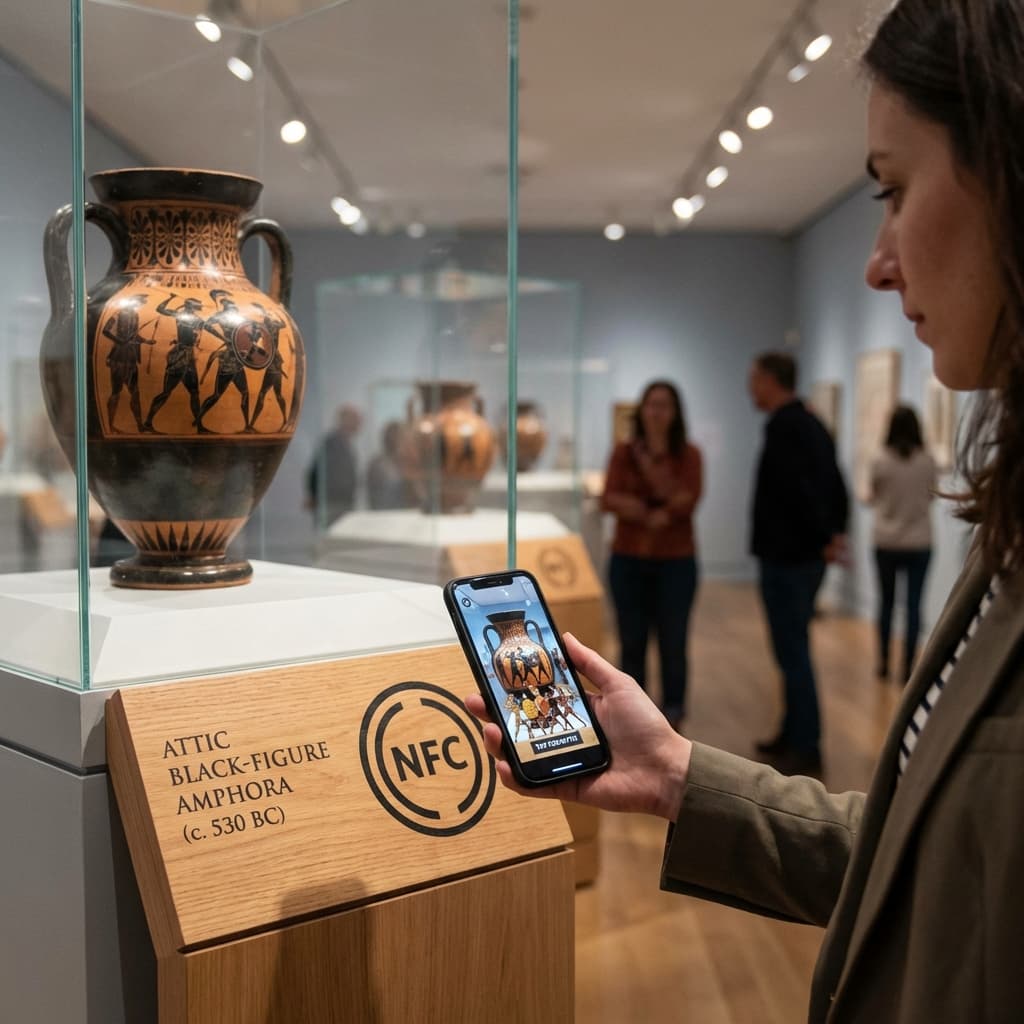
Physical Infrastructure: Small NFC tags are placed near exhibits—on walls, pedestals, or protective cases. Each tag costs $0.50-$2 depending on specifications.
The Visitor Experience:
- Visitor approaches an exhibit of interest
- Sees small "Tap to Learn More" indicator near the object
- Taps their smartphone against the NFC tag (takes 1-2 seconds)
- Phone instantly displays rich multimedia content about the exhibit
- Visitor can listen to audio, watch videos, view additional images, read in their preferred language, or dive deeper into related topics
- Content stays accessible on their phone—they can revisit it later or share with friends
No App Required: Modern smartphones (iPhone 7+ and most Android devices) read NFC tags natively. No app download, no QR code scanning, no typing URLs.
Backend System: Each NFC tag redirects to a unique URL on the museum's server. This allows:
- Dynamic Content: Update information without replacing physical tags
- Multilingual Support: Automatically detect device language and serve appropriate content
- Analytics: Track which exhibits generate most interest, when, and for how long
- Personalization: Adapt content based on visitor type, time of day, or visit history
Implementation Approaches
Museums can implement NFC in various ways depending on budget, technical capability, and institutional goals.
Approach 1: Basic Audio and Text
Simplest implementation. Each NFC tap leads to a mobile-optimized webpage with:
- Professional audio narration (2-5 minutes)
- High-quality images of the object from multiple angles
- Detailed text description (expandable—casual visitors read summary, interested visitors get full details)
- Artist/creator biography and historical context
Cost: $5,000-$25,000 for 100-exhibit museum Best For: Small museums, pilot programs, budget-conscious institutions
Approach 2: Multimedia Rich Content
Enhanced experience with video, interactive elements, and deeper storytelling:
- Video content (conservators discussing restoration, historians providing context, animated reconstructions)
- Image galleries (archival photos, X-rays revealing hidden details, comparative examples)
- Interactive timelines (place object in historical context)
- 3D models (rotate and zoom on artifacts)
- Related content links (connect thematically related exhibits)
Cost: $25,000-$75,000 for 100-exhibit museum Best For: Mid-size museums, institutions with strong digital teams, exhibitions focused on younger audiences
Approach 3: Augmented Reality Integration
Cutting-edge experiences that overlay digital content on physical world:
- Point phone camera at artifact to see it in original context (temple sculpture shown in reconstructed temple)
- AR reconstructions (damaged pottery reassembled digitally, faded paintings shown in original colors)
- Interactive AR experiences (ancient tools demonstrated in use, extinct animals appearing beside fossil skeletons)
- Gamification (AR scavenger hunts, educational quizzes with visual rewards)
Cost: $75,000-$200,000+ for comprehensive implementation Best For: Large institutions, special exhibitions, science and natural history museums
Approach 4: Personalized Journey Platform
Sophisticated systems that adapt to individual visitors:
- Visitor creates profile at entry (interests, knowledge level, preferred language, available time)
- System recommends personalized museum route
- Content adapts to visitor's engagement (casual browser gets summaries, engaged learner gets depth)
- Social features (share discoveries, see what friends found interesting)
- Post-visit engagement (follow-up content, donation appeals, event invitations)
Cost: $100,000-$500,000+ for full platform development Best For: Large museums with significant budgets, institutions prioritizing visitor data and long-term engagement
Real-World Applications and Use Cases
NFC technology enables specific museum innovations across different institution types.
Art Museums: Deeper Contextual Understanding
The Challenge: A painting on a wall tells a story, but visitors often lack context to fully appreciate it. Who was the artist? What was happening historically when it was painted? What techniques did the artist use? How does it relate to other works?
The NFC Solution: Tap the NFC tag beside the painting to access:
Artist Deep Dive:
- Biography with personal photos and letters
- Video showing the artist's studio and process
- Other works by the artist (in this museum and worldwide)
- Influence map (who influenced the artist, who they influenced)
Historical Context:
- Timeline showing what was happening in the world when painted
- Audio explaining the cultural significance
- Contemporary reviews and reactions
Technical Analysis:
- Infrared and X-ray imaging revealing underdrawings and changes
- Conservator commentary on techniques and materials
- Close-up details invisible from viewing distance
Personal Connections:
- Provenance (who owned it throughout history)
- Stories of how it came to the museum
- Visitor interpretations and favorite details
Case Study: The National Gallery, London Implemented NFC tags for its "Sensing the Unseen" exhibition. Visitors tapped to access:
- Infrared reflectograms showing artist's initial sketches
- Conservator video explaining how paintings were created
- AR reconstructions of how paintings originally looked before aging
Results:
- 68% of visitors used NFC features
- Average time per painting increased from 30 seconds to 4 minutes
- 89% reported "significantly enhanced understanding and appreciation"
- Visitor satisfaction scores increased 35%
- Strong social media sharing (visitors excited to share discoveries)
Natural History Museums: Bringing Extinct Species to Life
The Challenge: Fossils and skeletons are scientifically valuable but visually static. It's hard for visitors to imagine the living, breathing creatures they represent.
The NFC Solution: Tap beside a dinosaur skeleton to:
AR Reconstruction: Point camera at skeleton. Screen shows scientifically-accurate AR model of the living dinosaur, scaled to skeleton:
- Skin texture and coloration (based on latest research)
- Movement animation (walking, eating, interacting)
- Sounds (scientific recreation of vocalizations)
- Size comparison (stand next to AR dinosaur to appreciate scale)
Scientific Context:
- Discovery story (who found it, where, when)
- Ecosystem recreation (what else lived alongside it)
- Evolution timeline (how it relates to modern species)
- Ongoing research (what scientists are currently learning)
Interactive Elements:
- Quiz: Can you identify what this dinosaur ate?
- Comparison: How does its size compare to modern animals?
- Time Travel: See the landscape where it lived
Case Study: Smithsonian National Museum of Natural History NFC-enabled AR experiences for paleontology exhibits:
- Visitors tap and see T-Rex hunting in Cretaceous landscape
- Comparative size tools (stand next to life-size AR mammoth)
- Interactive food chain visualization
Results:
- Engagement time tripled (from 2 minutes to 6+ minutes per exhibit)
- Educational outcomes improved (quiz scores on content up 40%)
- Repeat visitation increased (visitors returned to show family/friends)
- Particularly effective with children (85% engagement rate among 6-14 age group)
History Museums: Personal Stories Behind Historical Events
The Challenge: Historic events feel abstract and distant. Dates, numbers, and facts lack emotional connection.
The NFC Solution: Tap beside historical artifacts to access personal narratives:
Primary Source Materials:
- Letters written by people who lived through events
- Diary entries describing daily life
- Photographs of real individuals
- Audio recordings (where available) of historical voices
Oral Histories:
- Video interviews with survivors, witnesses, descendants
- Multiple perspectives on same events
- Personal objects and their stories
Interactive Timelines:
- Place the artifact in broader historical context
- See what else was happening simultaneously
- Follow the story forward (consequences and outcomes)
Case Study: United States Holocaust Memorial Museum Implemented "ID Card" NFC system:
- Each visitor taps to receive identity of a real person from the Holocaust
- Throughout museum, tap stations reveal what happened to "your person" at each stage
- Creates profound personal connection to history
- Transforms abstract tragedy into individual human stories
Results:
- Visitor emotional engagement dramatically increased
- Educational retention improved significantly
- Post-visit reflection and discussion deepened
- Donation and membership conversion rates increased
Science Museums: Interactive Demonstrations and Experiments
The Challenge: Scientific concepts are often abstract and difficult to visualize. Static displays of equations or apparatus don't convey the excitement of discovery.
The NFC Solution: Tap beside scientific exhibits to:
Interactive Simulations:
- Physics simulations (manipulate variables, see results)
- Chemistry visualizations (molecular structures you can rotate and explore)
- Mathematical concepts illustrated dynamically
Video Demonstrations:
- Scientists performing experiments
- Slow-motion footage of chemical reactions
- Microscopic and telescopic views
Hands-On Challenges:
- "Try it yourself" experiments visitors can do at home
- Citizen science opportunities (contribute to real research)
- STEM career explorations
Gamified Learning:
- Collect achievements for exploring topics
- Solve challenges to unlock advanced content
- Compete with friends on scientific knowledge
Case Study: Exploratorium, San Francisco NFC-enhanced physics exhibits:
- Tap to see invisible forces visualized (magnetism, gravity, air pressure)
- Slow-motion videos of phenomena happening too fast to see
- Interactive calculators (measure your own jump, calculate force)
- Connection to everyday life (where do you experience this physics?)
Results:
- Visitor understanding of complex concepts improved measurably
- Time spent with exhibits increased 2.5x
- Return visits specifically to explore NFC content increased
- Strong word-of-mouth and social sharing
Implementation Guide for Museums
Transitioning to NFC-enhanced experiences requires thoughtful planning.
Step 1: Assessment and Strategy
Institutional Readiness: Before implementing, assess:
- Technical Capability: Do you have staff who can manage digital content?
- Budget: What can you realistically invest? (Start small if needed)
- Content Assets: Do you have existing digital content (audio, video, images) or must you create from scratch?
- Visitor Demographics: Who visits your museum? (Tech comfort varies by audience)
- Strategic Goals: What outcomes do you want? (Increased engagement? Younger visitors? Better educational outcomes?)
Pilot Program: Don't implement museum-wide immediately. Start with:
- Single exhibition or gallery (10-25 exhibits)
- 3-6 month trial period
- Comprehensive visitor feedback collection
- Metrics tracking (usage rates, engagement time, satisfaction)
- Budget: $5,000-$15,000 for meaningful pilot
Success Criteria: Define what success looks like:
- X% of visitors use NFC features
- Engagement time increases by Y%
- Visitor satisfaction scores improve by Z points
- Positive ROI within specified timeframe
Step 2: Content Development
Content quality matters more than technology sophistication.
Content Audit: Inventory existing assets:
- Exhibition text and labels
- Scholarly research on collections
- Archival photographs and documents
- Previous audio guide scripts
- Video footage from documentaries or programs
- Curatorial expertise (staff knowledge not yet documented)
Content Strategy: For each exhibit, determine:
- Core Message: What's the one thing visitors should understand?
- Tiered Information: Summary (30 seconds), standard (2-3 minutes), deep dive (5+ minutes)
- Media Mix: What combination of audio, video, images, and text serves the content best?
- Multilingual Needs: Which languages are priority for your visitor demographics?
Production Approach:
Option 1: In-House Production Leverage existing staff and simple tools:
- Curators write scripts, record narration on smartphones
- Use free/low-cost editing software
- Museum photographer provides images
- Simple mobile-optimized web pages
Cost: Staff time (minimal cash expense) Quality: Variable, depends on staff skills Best For: Small museums, tight budgets, pilot programs
Option 2: Hybrid Approach Combine in-house expertise with professional production:
- Curators develop content and scripts
- Hire professional voice talent for audio ($500-$2,000)
- Hire videographer for select key exhibits ($2,000-$10,000)
- Work with web developer for polished presentation ($5,000-$15,000)
Cost: $10,000-$30,000 for 50-exhibit implementation Quality: Professional but cost-effective Best For: Mid-size museums, permanent collection enhancement
Option 3: Full Professional Production Museum-quality multimedia content:
- Professional scriptwriters and content strategists
- Recorded in studio with professional voice talent
- High-quality video production with lighting, editing, graphics
- AR/3D modeling specialists
- Comprehensive accessibility features (closed captions, audio descriptions, etc.)
Cost: $50,000-$200,000+ for comprehensive implementation Quality: World-class experiences competitive with commercial entertainment Best For: Major museums, blockbuster exhibitions, institutions with significant budgets
Accessibility Requirements: Ensure content serves all visitors:
- Hearing Impaired: All audio has text transcripts
- Visually Impaired: Audio descriptions of visual content, screen-reader compatible pages
- Cognitive Accessibility: Clear, simple language options; visual organization
- Language Access: Content in multiple languages based on visitor demographics
Step 3: Technical Implementation
Choosing NFC Tags:
Tag Specifications:
- Memory: 144-888 bytes (sufficient for URL storage)
- Type: NTAG213 or NTAG215 (excellent smartphone compatibility)
- Form Factor: Adhesive labels for most applications, hard tags for outdoor/high-traffic areas
- Durability: Consider environment (indoor climate-controlled vs. outdoor exposure)
- Aesthetics: Clear labels, custom-printed tags, or completely hidden tags (behind wall panels)
Cost: $0.50-$3 per tag depending on quantity and specifications
Physical Installation:
- Placement: Near exhibits but not intrusive to viewing experience
- Visibility: Clear "tap here" indicators without cluttering gallery aesthetics
- Accessibility: Reachable for wheelchair users, children, and people of all heights
- Security: Positioned to prevent accidental damage or theft
Digital Infrastructure:
Option 1: Simple Web Hosting Each NFC tag points to a static web page on your existing website.
Pros:
- Minimal technical complexity
- Low cost (uses existing web hosting)
- Easy to maintain
Cons:
- No analytics (can't track usage)
- No personalization
- Limited interactivity
Best For: Pilot programs, small museums, budget implementations
Option 2: Content Management Platform Use specialized museum CMS (Cuseum, GuideGuide, Bloomberg Connects).
Pros:
- Built for museum use cases
- Analytics dashboard included
- Multilingual support built-in
- Easy content updates for non-technical staff
- Mobile app integration options
Cons:
- Monthly subscription fees ($200-$2,000/month depending on size)
- Less customization than custom development
- Platform lock-in
Best For: Most museums, especially those without in-house development teams
Option 3: Custom Development Build proprietary system tailored to your institution's needs.
Pros:
- Complete control and customization
- Can integrate with existing systems (ticketing, CRM, etc.)
- No ongoing platform fees (just hosting)
- Ownership of all code and data
Cons:
- High upfront development cost ($50,000-$200,000+)
- Requires ongoing maintenance and technical staff
- Longer implementation timeline
Best For: Large institutions, museums with unique requirements, those with in-house technical teams
Step 4: Visitor Communication and Onboarding
Technology is useless if visitors don't know it exists or how to use it.
Pre-Visit Communication:
- Website mentions NFC-enhanced exhibits
- Email to members announcing feature
- Social media teasers showing example interactions
- Online ticketing includes informational note
On-Site Orientation:
- Signage at entrance explaining NFC features
- Staff trained to demonstrate and encourage usage
- Laminated quick-start cards available
- Video demonstration playing in lobby
In-Gallery Prompts:
- First NFC tag in each gallery includes step-by-step instructions
- Visual design clearly indicates "tap here with your phone"
- Icons showing smartphone position/orientation
- Backup QR codes for phones without NFC capability
Troubleshooting Support:
- Staff equipped to help (how to enable NFC in phone settings, what phones are compatible)
- Help desk or roaming staff during initial rollout
- FAQs posted on website and in galleries
Step 5: Measurement and Iteration
Continuously improve based on data and feedback.
Analytics to Track:
- Usage Rate: What percentage of visitors tap NFC tags?
- Engagement Rate: Of those who tap, how many engage with content (vs. immediately leaving)?
- Time on Content: How long do visitors spend with digital content?
- Completion Rate: Do visitors finish audio/video, or drop off partway?
- Popular Content: Which exhibits generate most NFC interactions?
- Device Types: iOS vs. Android usage patterns
- Language Selection: Which languages are being used?
Visitor Feedback:
- Exit surveys (digital and paper)
- Comment cards specific to NFC experience
- Social media monitoring
- Direct observation (watch visitors interact)
Iteration Cycle:
- Monthly review of analytics
- Quarterly content updates (refresh underperforming content, expand popular topics)
- Annual comprehensive assessment
- Ongoing refinement based on visitor behavior
Cost-Benefit Analysis
Is NFC implementation financially justifiable for museums?
Costs: 100-Exhibit Museum Example
Initial Implementation:
- NFC tags: 100 x $1.50 = $150
- Content development: $15,000 (hybrid approach, mix of in-house and professional)
- Digital infrastructure: $5,000 (CMS setup and first year)
- Design and installation: $2,000
- Staff training: $1,000
Total Initial Investment: $23,150
Ongoing Annual Costs:
- CMS platform: $3,600/year
- Content updates: $3,000/year (refresh 20% of content annually)
- Tag replacement: $200/year (wear and tear)
Total Annual Cost: $6,800
Benefits
Increased Visitation: Better visitor experience drives word-of-mouth and return visits.
- If NFC enhances experience, expect 5-10% increase in repeat visitation
- For museum with 50,000 annual visitors at $15 admission: 2,500 additional visits x $15 = $37,500 additional revenue
Membership Conversion: Enhanced experience increases membership conversion rates.
- If 2% of visitors convert to members at $75/year
- NFC implementation improves conversion by 0.5 percentage points
- 50,000 visitors x 0.5% x $75 = $18,750 additional membership revenue
Donation Increases: Engaged visitors donate more.
- Museums with strong digital experiences see 15-25% increase in donation conversion
- If 10% of visitors donate an average of $20
- 15% increase: 50,000 x 10% x $20 x 15% = $15,000 additional donations
Education Program Revenue: Schools pay more for enhanced educational experiences.
- If museum runs school programs for 5,000 students at $10/student
- NFC content allows $2 price increase due to enhanced educational value
- 5,000 x $2 = $10,000 additional revenue
Reduced Audio Guide Costs: Eliminate traditional audio guide infrastructure.
- Annual audio guide maintenance, staff, and equipment: $15,000
- NFC eliminates this cost = $15,000 saved
Total Annual Benefit: $96,250
Net ROI:
- First Year: $96,250 - $23,150 - $6,800 = $66,300 profit (286% ROI)
- Subsequent Years: $96,250 - $6,800 = $89,450 annual profit (1,315% ROI)
This doesn't account for intangible benefits:
- Enhanced institutional reputation
- Improved educational outcomes
- Greater accessibility for diverse audiences
- Data insights on visitor behavior
- Reduced environmental impact (no disposable printed materials)
Future of Museum Technology
NFC is a foundation for evolving museum experiences.
Personalized Museum Journeys
AI-powered recommendation engines:
- Create custom routes based on visitor interests and available time
- Adapt difficulty/depth of content to visitor's knowledge level
- Learn from behavior (if visitor skips video content, offer more images/text)
- Connect across visits (remember where you left off, suggest related exhibits)
Social and Collaborative Experiences
Museums become social platforms:
- See what exhibits friends found interesting
- Leave comments and reflections for other visitors
- Collaborative challenges (team scavenger hunts, group problem-solving)
- Post-visit discussion forums centered on specific exhibits
Blockchain-Based Provenance and Authentication
Immutable records of artwork history:
- Verify authenticity and ownership history
- Digital certificates of authenticity for purchased reproductions
- NFT tie-ins for special exhibitions
Extended Reality (XR) Integration
Beyond AR to full virtual experiences:
- Virtual museum visits for those who can't travel
- "Time travel" experiences (see the gallery as it looked in different eras)
- Impossible exhibitions (display objects too fragile to show physically)
Conclusion: Museums That Engage the Digital Generation
The museum mission hasn't changed: collect, preserve, research, educate, and inspire. But the methods must evolve.
Today's visitors—especially younger generations—expect interactivity, personalization, and multimedia storytelling. Museums that cling to purely analog interpretation risk irrelevance. Yet those that embrace technology thoughtfully can enhance their educational impact while honoring their cultural mission.
NFC technology offers an ideal bridge: sophisticated digital experiences delivered through visitors' personal devices, requiring minimal museum infrastructure. It's affordable, scalable, and increasingly familiar to visitors already using contactless payments and smart home devices.
More importantly, NFC enhances rather than replaces the core museum experience. It doesn't distract from objects—it deepens understanding of them. It doesn't isolate visitors in headphones—it can facilitate shared discovery and conversation.
The artifacts remain the stars. The technology simply helps them tell their stories more effectively to 21st-century audiences.
For museums facing budget constraints, declining attendance, or generational engagement challenges, NFC implementation offers measurable ROI alongside mission fulfillment. It's not about being trendy—it's about being relevant, accessible, and effective.
The visitors are already carrying the technology in their pockets. The content is already in your curatorial expertise and archives. The infrastructure is affordable and implementable within realistic budgets.
The question isn't whether to enhance your museum with interactive technology. It's whether you can afford not to—when competitors, changing visitor expectations, and the imperative to remain culturally relevant all point in the same direction.
Make history come alive. Let artifacts speak. Give visitors the tools to discover, explore, and connect with your collections in ways that match how they engage with information in the rest of their lives.
Welcome to the interactive museum. Your visitors are ready. Their phones are ready. Your collections deserve to be experienced to their fullest potential.
The future of museums isn't about abandoning the physical for the digital. It's about using the digital to make the physical more meaningful, memorable, and impactful than ever before.