A couple drives through a neighborhood on a Sunday afternoon, casually house-hunting. They spot a charming home with a "For Sale" sign on the lawn. Interested, but the open house was yesterday. Now what?
Traditional path: Note the agent's name and phone number from the sign, search for the listing online later (if they remember), call during business hours to schedule a private showing days or weeks away. By then, they've seen a dozen other houses and this one has faded from memory—or worse, it's already under contract.
The problem is timing. Real estate is about capturing interest at the peak moment of emotional engagement—when someone is standing in front of the house, visualizing themselves living there. But traditional marketing tools (yard signs, printed flyers) provide minimal information at that crucial moment.
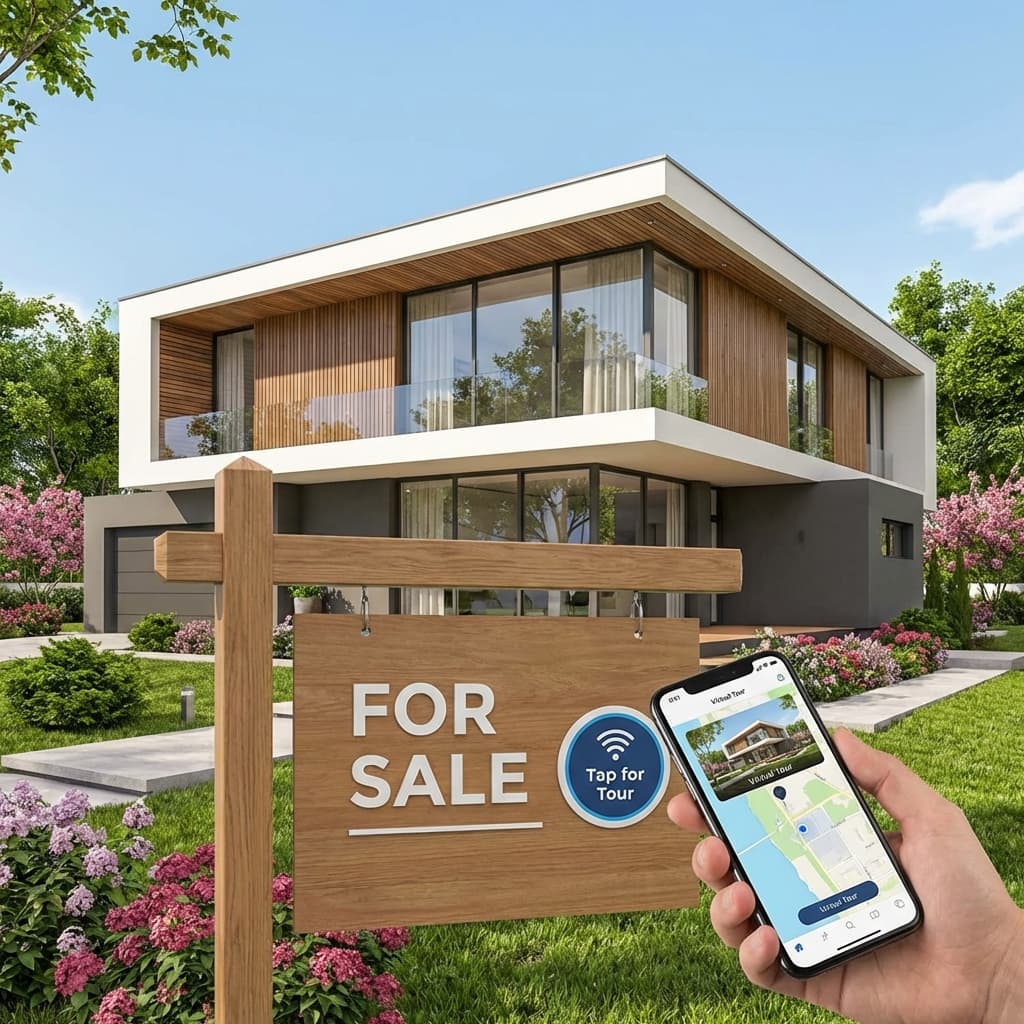
NFC technology solves this by transforming "For Sale" signs from simple markers into instant information portals. A quick smartphone tap delivers everything a buyer wants to know: price, photos, virtual tours, floor plans, neighborhood data, and instant scheduling—all while they're still standing in front of the property, imagination engaged.
The Real Estate Marketing Challenge
Understanding the problem requires examining how buyers actually behave.
The Drive-By Reality
According to the National Association of Realtors:
- 87% of buyers drive through neighborhoods before deciding where to search
- The average buyer tours 10 homes before purchasing
- 76% discover interesting properties while driving or walking, not through online searching
- Peak interest occurs in the first 30 seconds of seeing a property
Yet traditional yard signs provide only:
- Agent's name and phone number
- Brokerage logo
- Occasionally a website URL (which buyers must manually type on their phones)
This creates massive friction at the exact moment when emotional interest is highest. By the time buyers get home, research the property online, and contact the agent, their attention has scattered across multiple properties and competing priorities.
The Information Gap
Modern home buyers want comprehensive information immediately:
- Asking price and price history
- Number of bedrooms, bathrooms, square footage
- Interior photos (kitchen, bathrooms, master bedroom especially)
- Virtual walkthrough or video tour
- Property history (when built, previous sale prices, time on market)
- Neighborhood data (schools, crime rates, walkability scores, nearby amenities)
- HOA fees and restrictions
- Tax information
- Open house schedules
- Agent availability for showings
Providing all this on a physical sign is impossible. Even QR codes require multiple steps: open camera, focus, scan, wait for redirect, navigate website. Many potential buyers skip this process entirely.
The Missed Lead Problem
Real estate is fundamentally about lead generation. Every interested buyer who doesn't convert into a showing is lost opportunity.
Traditional "For Sale" Sign Conversion:
- 1,000 drive-bys per week
- 5% stop to note information: 50 people
- 20% actually follow up later: 10 people
- 50% of those schedule showings: 5 showings
Lost Opportunity: 995 people who saw the property didn't convert into leads. Most weren't disinterested—they just encountered too much friction.
Agent Availability Bottleneck
Buyers operate on their own schedules, often browsing neighborhoods on evenings and weekends. But reaching agents and scheduling showings introduces delays:
- Call during business hours (not when you're driving by on Saturday afternoon)
- Play phone tag
- Coordinate schedules
- Wait days for available showing slot
- By then, maybe you've lost interest or seen something better
Meanwhile, the emotional peak moment when they were standing in front of the house, imagining their furniture in the living room, has passed.
The Virtual Tour Revolution
COVID-19 accelerated adoption of virtual tours and 3D property walkthroughs (Matterport, Zillow 3D Home, etc.). Buyers now expect to preview homes virtually before investing time in physical showings.
But these virtual experiences are typically accessed only by buyers who find the listing online. Those discovering properties through neighborhood exploration—a huge percentage—miss out unless the listing is easily accessible from the yard sign.
The NFC Solution: Instant Property Information
NFC technology bridges the gap between physical discovery and digital information.
How Real Estate NFC Works
Physical Implementation: NFC tag embedded in or attached to "For Sale" sign. These tags are:
- Weather-resistant (outdoor-rated, IP65 or higher)
- Durable (withstand sun, rain, wind, temperature extremes)
- Secure (tamper-evident, lockable sign installations)
- Affordable ($2-5 per tag)
The Buyer Experience:
- Drive by property, notice "For Sale" sign with "Tap for Info" indicator
- Park and approach sign
- Tap smartphone on NFC tag (1-2 seconds)
- Instantly access comprehensive property information on mobile-optimized webpage
- Browse photos, watch virtual tour, view price and details
- Schedule showing with one tap or save listing to favorites
- Continue drive, secure in knowledge they can access information anytime from saved link
No App Required: Works with iPhone 7+ and most Android devices natively. No special app download needed.
Backend System: NFC tag redirects to property-specific landing page hosted on agent/brokerage website. This allows:
- Dynamic Updates: Change price, status, or open house times without replacing physical tags
- Analytics: Track how many taps per property, time of day, conversion to showings
- Lead Capture: Optional form for buyers to request more info or schedule showing
- CRM Integration: Automatically add interested buyers to agent's follow-up system
Implementation Approaches
Real estate professionals can deploy NFC at various scales.
Approach 1: Individual Agent Implementation
Single agents add NFC to their personal listings.
What's Included:
- NFC tags for each listing ($2-5 per tag)
- Landing page on agent's website for each property
- Basic property information, photos, contact form
- Link to MLS listing or virtual tour
Cost: $10-25 per listing (one-time)
Best For:
- Independent agents
- Testing NFC effectiveness
- Tech-savvy agents wanting competitive differentiation
Approach 2: Team or Brokerage-Wide Implementation
Real estate team or brokerage deploys NFC across all listings.
What's Included:
- Standardized NFC-enabled yard signs for all team listings
- Branded landing page template (consistent look across all properties)
- CRM integration (leads flow automatically into team's system)
- Analytics dashboard (track performance across all listings)
- Automated updates (status changes, price reductions reflected immediately)
Cost: $5,000-$15,000 setup + $5-10 per listing
Best For:
- Real estate teams (5+ agents)
- Boutique brokerages
- Teams emphasizing technology differentiation
Approach 3: Enterprise Platform Integration
Large brokerages integrate NFC into comprehensive digital marketing platform.
What's Included:
- Custom-branded sign riders with embedded NFC
- Advanced lead capture and attribution (track which signs generate most leads)
- A/B testing (test different landing page designs, CTAs, information presentation)
- Multi-language support (important in diverse markets)
- Integration with existing tech stack (CRM, transaction management, marketing automation)
- Reporting and ROI analysis
Cost: $25,000-$100,000+ for platform development and rollout
Best For:
- Large brokerages (50+ agents)
- Franchises rolling out company-wide
- Luxury real estate firms emphasizing cutting-edge marketing
What to Include on NFC Landing Pages
Content strategy matters as much as technology.
Essential Information (Minimum Viable Product)
Property Basics:
- Address (unless privacy concerns for occupied homes)
- Asking price
- Bedrooms, bathrooms, square footage
- Lot size
- Year built
- Property type (single-family, condo, townhome, etc.)
Visual Tour:
- Photo gallery (10-20 high-quality images minimum)
- Virtual 3D tour (Matterport or similar)
- Video walkthrough (2-3 minutes, professionally shot)
- Aerial drone footage (for properties with significant land or impressive exteriors)
Key Features:
- Highlighted upgrades (new kitchen, renovated bathrooms, etc.)
- Unique selling points (view, location, historical significance, etc.)
- Included appliances and fixtures
- Recent improvements
Call-to-Action:
- Schedule a showing (calendar integration, one-tap booking)
- Request more information (lead capture form)
- Contact agent (click-to-call, click-to-text, email)
- Save listing (add to favorites, email details to yourself)
Advanced Content (Competitive Differentiation)
Neighborhood Intelligence:
- School ratings and proximity
- Walk Score, Transit Score, Bike Score
- Nearby amenities (parks, restaurants, grocery stores, gyms)
- Crime statistics
- Demographic data
- Future development plans (new schools, shopping centers, infrastructure)
Financial Details:
- Property tax amount
- HOA fees and what they cover
- Estimated monthly payment calculator
- Historical sale prices and appreciation rates
- Cost comparison to neighborhood average
Interactive Features:
- Mortgage calculator (buyers input down payment and see monthly payment)
- Room visualizer (see rooms with different paint colors or furniture arrangements via AR)
- Compare to other listings (side-by-side with similar properties)
- Neighborhood tour (additional NFC tags throughout neighborhood highlighting local attractions)
Agent Credibility:
- Agent bio and photo
- Recent sales in the area
- Client testimonials
- Professional certifications
- Market expertise (specialized knowledge of this neighborhood)
Urgency Indicators:
- Days on market
- Number of showings already scheduled
- Upcoming open house dates
- "Hot property" indicator if getting high interest
Content Customization by Property Type
Luxury Homes ($1M+):
- Cinematic video tours with music and professional voiceover
- Architect and builder information
- Custom finishes and materials details
- Smart home technology features
- Security system information
- Lifestyle photography (entertaining spaces, wine cellars, home theaters)
First-Time Buyer Homes:
- Simplified, educational content
- Down payment assistance program information
- First-time buyer resources
- Neighborhood "starter home" success stories
- Affordability emphasis
Investment Properties:
- Rental income potential
- Cap rate calculations
- Occupancy history
- Comparable rental rates
- Investor-specific ROI data
Vacant Land:
- Topographical maps
- Buildable area analysis
- Zoning information and allowable uses
- Utility availability
- Environmental considerations
- Conceptual home renderings (what could be built)
Real-World Use Cases and Success Stories
NFC adoption in real estate is growing rapidly.
Case Study 1: Suburban Family Homes
Agent: Sarah Chen, suburban Chicago market Implementation: Added NFC tags to 12 active listings Cost: $150 total ($12.50 per listing)
Results (6-month period):
- 2,847 total NFC taps across all listings
- Average 237 taps per listing
- 14% conversion to showing requests (398 scheduled showings)
- 23% increase in showing volume vs. non-NFC comparable listings
- Average days-on-market decreased from 42 to 31 days
- 3 sales directly attributed to NFC-generated leads
ROI Calculation: 3 sales × $12,000 average commission = $36,000 revenue Investment: $150 ROI: 24,000%
Agent Testimonial: "Buyers love it. They're standing in front of the house, excited, and instead of writing down a phone number to call later, they tap and instantly see everything. The emotional engagement translates directly into scheduling. I can't imagine going back to traditional signs."
Case Study 2: Luxury Waterfront Properties
Brokerage: Coastal Elite Realty, Florida Implementation: NFC-enabled signs for luxury listings ($2M+) Investment: $25,000 (comprehensive platform with high-end landing pages and video content)
Enhanced Content Included:
- 4K drone cinematography
- 3D Matterport tours
- Architect interviews (for custom homes)
- Sunset time-lapse videos
- Neighborhood prestige content
Results (12-month period):
- 38 luxury listings with NFC
- Average 412 taps per listing
- 28% conversion to private showing requests
- Captured leads from out-of-state buyers browsing neighborhoods during vacation
- 11 sales where NFC was first point of contact
ROI: 11 sales × $75,000 average commission = $825,000 revenue Investment: $25,000 ROI: 3,300%
Broker Testimonial: "In luxury real estate, presentation is everything. NFC lets us deliver a five-star experience from the moment someone sees our sign. It's not just information—it's a statement about how we do business."
Case Study 3: Urban Condo Development
Developer: Metro Living Developments, Seattle Implementation: NFC tags on building exterior signage for new condo development Units: 87 condos, $400K-$900K each
NFC Landing Page Features:
- Available units with real-time pricing
- Virtual model unit tour
- Building amenity videos (rooftop deck, gym, coworking space)
- Neighborhood walkability content
- Financing partner information
- Reservation system (hold unit with deposit)
Results:
- 5,200+ taps in first 90 days
- 673 lead capture form completions
- 89 showing requests
- 31 reservations made directly through NFC landing page
- Sold 60% of units before building completion
Developer Insight: "People walk or drive by the construction site, wonder what's being built, and can tap to instantly see everything. We captured high-intent leads that would have simply walked away with traditional marketing. The NFC sign was our best-performing marketing channel by cost per lead."
Implementation Guide for Real Estate Professionals
Step-by-step deployment for agents and brokerages.
Step 1: Choose Your NFC Sign Strategy
Option A: Sign Riders Attach NFC-enabled rider to existing "For Sale" signs.
- Pros: Works with current sign inventory, affordable, easy to deploy
- Cons: Additional piece to manage, potential for theft/damage
- Cost: $5-15 per rider
Option B: Integrated Signs "For Sale" signs with built-in NFC tags.
- Pros: Cleaner aesthetic, more durable, harder to steal
- Cons: Higher initial cost, must replace entire sign
- Cost: $25-50 per sign
Option C: Post-Mounted Tags NFC tag attached to sign post or lockbox.
- Pros: Very low cost, can't be stolen with sign, reusable
- Cons: Less visible, may require users to search for tap point
- Cost: $2-5 per tag
Recommendation: Start with sign riders for first 5-10 listings to test effectiveness. If results are strong, transition to integrated signs for professional, permanent solution.
Step 2: Create Property Landing Pages
Quality content drives conversion.
DIY Approach (Budget: $0-$500):
- Use existing MLS photos
- Create simple mobile-optimized page on your website
- Embed existing virtual tour (if available)
- Include contact form
- Link to full MLS listing
Tools: WordPress, Squarespace, Wix (most support mobile pages and forms) Time Investment: 1-2 hours per property Best For: Tech-comfortable agents, low-volume listings, testing phase
Semi-Professional (Budget: $500-$2,000 per property):
- Hire photographer for professional listing photos ($200-$400)
- Create Matterport 3D tour ($150-$300)
- Commission 2-minute video walkthrough ($500-$1,000)
- Professional web designer creates custom landing page ($300-$500)
Best For: Mid-market and luxury properties, agents with moderate budgets
Premium (Budget: $2,000-$10,000+ per property):
- Professional photography and twilight shots ($500-$1,000)
- 4K drone videography ($800-$1,500)
- Cinematic video tour with music and voiceover ($2,000-$5,000)
- 3D Matterport tour ($300-$500)
- Professional copywriter for property description ($300-$500)
- Custom-designed, branded landing page ($1,000-$2,000)
Best For: Luxury properties ($1M+), unique properties, competitive markets
Step 3: Set Up Analytics and Lead Tracking
Measure what matters.
Metrics to Track:
- Taps per property: How many people are engaging?
- Tap timing: What days/times generate most interest?
- Session duration: How long do users spend on landing page?
- Conversion rate: Taps → showing requests ratio
- Lead quality: How many NFC-generated leads result in showings? Offers? Closings?
Tools:
- Google Analytics: Free, comprehensive, tracks page views and behavior
- CRM Integration: Ensure leads flow into your existing CRM (Follow Up Boss, LionDesk, etc.)
- Custom Dashboards: For teams/brokerages, build dashboard showing NFC performance across all listings
Lead Attribution: Tag NFC-generated leads in your CRM so you can track them through closing and calculate true ROI.
Step 4: Promote the Feature
Educate buyers and differentiate your marketing.
Listing Marketing:
- Mention "Tap for instant info" in all property marketing
- Include photos of the NFC sign in MLS listing
- Social media posts demonstrating how to use it
- Email to sphere: "I've upgraded to smart yard signs—check out [address]"
Agent Branding:
- "I use smart technology to market your home" (seller value proposition)
- Website and marketing materials highlight NFC capability
- Tech-forward brand positioning
Buyer Education:
- Blog post or video: "How to Use Our Smart Yard Signs"
- Open house demonstration
- Email to buyer leads explaining the feature
Step 5: Iterate Based on Data
Continuously improve.
What to Test:
- Different landing page layouts (photo gallery first vs. video first)
- Call-to-action placement (top of page vs. bottom)
- Lead capture timing (immediate form vs. after browsing)
- Content depth (brief summary vs. comprehensive details)
- Additional features (mortgage calculator, neighborhood data, etc.)
Optimization Cycle:
- Review analytics monthly
- Identify underperforming listings (low taps or low conversion)
- Hypothesize why (poor sign placement, weak content, etc.)
- Make adjustments
- Measure impact
Cost-Benefit Analysis
Is NFC worth it for your real estate business?
Investment: Individual Agent (10 active listings)
Initial Costs:
- NFC sign riders: 10 × $10 = $100
- Landing page setup: $500 (one-time, create template)
- Photography upgrade (not strictly NFC-related but recommended): $2,000 (across 10 listings)
Total Initial Investment: $2,600
Ongoing Costs:
- Minimal (NFC tags reusable, landing page template reusable)
- Hosting/domain: $15/month = $180/year
Benefits
Increased Showing Volume: Conservative estimate: 15% increase in showing requests
- Typical: 50 showings/year across 10 listings = 7-8 additional showings
- Showing-to-offer rate: 20%
- Additional offers: 1-2 per year
Faster Sales: Increased showing volume and lead capture shortens days-on-market
- Faster sale = less holding cost for sellers (property taxes, utilities, maintenance)
- Competitive advantage in listing presentations ("I use the latest technology")
Additional Closed Transactions: Even one additional closing due to NFC-generated lead:
- 1 sale × $10,000 average commission = $10,000 revenue
ROI: First Year: $10,000 - $2,600 - $180 = $7,220 profit (278% ROI) Subsequent Years: Minimal ongoing cost, continued lead generation
Intangible Benefits:
- Listing presentation differentiation (win more seller clients)
- Brand positioning as tech-forward agent
- Better buyer experience (stronger relationships, more referrals)
- Time savings (fewer "what's the price?" phone calls, information pre-qualified)
Future of Real Estate NFC Technology
Innovation continues.
Neighborhood-Wide Smart Networks
Future: Entire neighborhoods with NFC-enabled infrastructure.
- Tap sign at neighborhood entrance for overview of all available homes
- Tap at park to see homes near green space
- Tap at school to see homes in that district
- Tap at transit stop to see homes within walking distance
Creates comprehensive location-based property discovery.
AI-Powered Personalization
Landing pages that adapt to user:
- First-time visitor sees comprehensive information
- Return visitor sees updates since last visit
- Investor sees ROI data
- Family sees school information
Machine learning identifies what content converts best for different buyer types.
Augmented Reality Integration
Tap sign, point camera at house, see:
- Property lines overlaid on view
- Room dimensions and layout shown through walls
- Furniture placement suggestions via AR
- Renovation potential (see kitchen with different cabinets, etc.)
Blockchain Integration
Property history and documentation on blockchain:
- Tap to verify property ownership history
- Access inspection reports and disclosures
- Review title history
- Immutable record of property information
Smart Home Integration
For new construction or smart homes:
- Tap to see live video from interior cameras (with permission)
- View real-time energy usage data
- See smart home features demonstration
- Schedule remote smart lock access for self-showing
Conclusion: Meeting Buyers Where They Are
Real estate has always been about location, location, location. Now it's also about information, information, information—delivered at the right place and right time.
The right place: standing in front of the property, imagination engaged. The right time: immediately, when interest is peaked.
NFC technology delivers both. It removes friction between discovery and information, between interest and action. It captures the emotional peak moment when someone falls in love with a house's curb appeal and translates that into concrete next steps.
For agents, it's a force multiplier. Your yard sign is no longer a passive marker—it's an active lead generation tool working 24/7. Every drive-by becomes an opportunity. Every tap is a qualified lead who took action because they were interested.
For buyers, it's empowerment. Immediate access to information on their terms, without phone calls or waiting. The ability to tour virtually before committing time to physical showings. Research at their own pace, share with partners, make informed decisions faster.
The technology is proven, affordable, and increasingly expected by tech-savvy buyers. Implementation is straightforward. ROI is measurable. The competitive advantage is clear.
The question isn't whether NFC will become standard in real estate marketing—it's whether you'll be an early adopter who captures the benefits or a late follower playing catch-up.
Your yard signs are already out there. Your listings already have photos and virtual tours. You're already marketing properties. NFC simply makes all of it more accessible, more effective, and more valuable to the buyers you're trying to reach.
Transform your "For Sale" signs from simple markers into instant information portals. Your sellers will appreciate the cutting-edge marketing. Your buyers will appreciate the convenience. Your commission checks will appreciate the results.
Welcome to real estate marketing that works as hard as you do—24 hours a day, 7 days a week, instantly accessible with a simple tap.
The buyers are driving through neighborhoods right now. Their phones are in their pockets. Your properties deserve to be discovered, explored, and ultimately purchased.
Give them what they want, when they want it, where they want it. Everything else is just a sign.